
Knowledge centre
Frequently asked questions
Short answers to what people ask most when choosing conduit, fittings and protection ratings. If your question is not here, write to us.
Choosing a product
What is a flexible steel conduit and what is it for?
A flexible steel conduit is a cable protection tube made by winding steel strip into a square-lock profile. It protects cables from crushing, cutting and high temperatures, and is used in machinery, control panels and building installations.
What is the difference between galvanized and stainless conduit?
The difference is operating temperature and corrosion resistance. Galvanized steel is used from −50 °C to +300 °C and stainless steel (304/316L) from −100 °C to +600 °C. Stainless is preferred in corrosive environments.
How does PVC-coated conduit differ from liquid-tight conduit?
PVC-coated conduit is rated IP54–IP65 and operates from −25 °C to +90 °C. Liquid-tight conduit has a thicker jacket, is rated IP66–IP68 and can be used up to +105 °C.
Which sizes are the conduits made in?
Flexible steel conduits are made in 18 sizes from 1/4" to 4" (inner diameter 9–102 mm), and so is the guide-wire series. The braided series come in 8 sizes from 1/4" to 2".
What is polyamide corrugated conduit and where is it used?
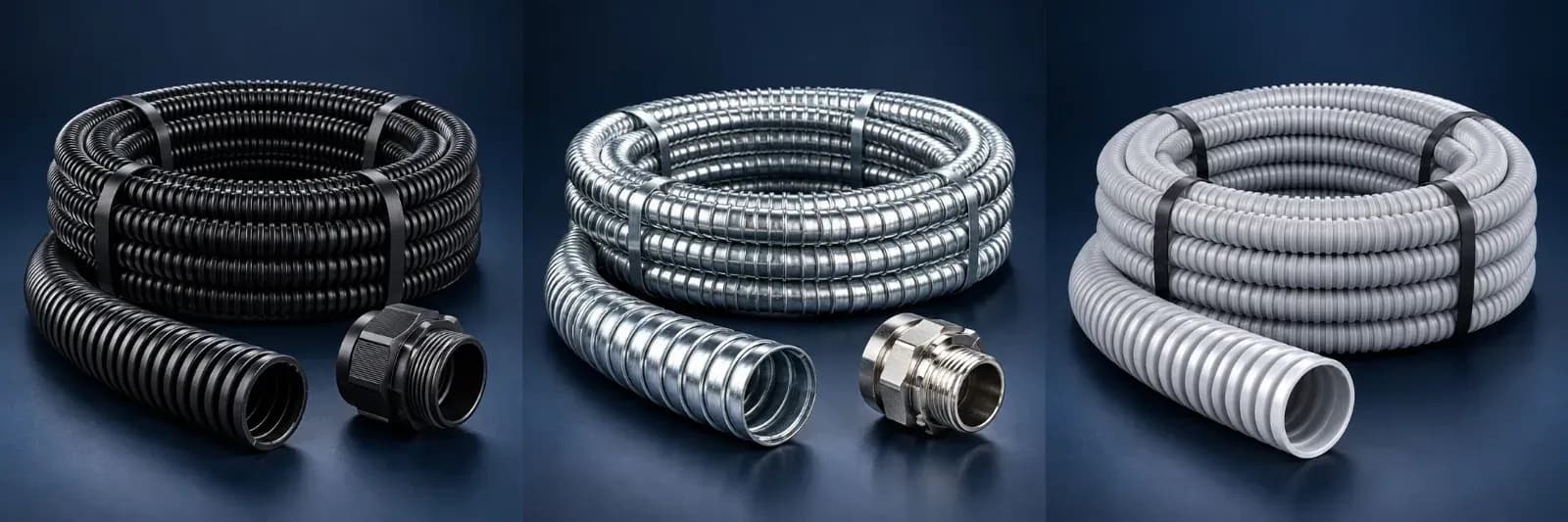
Polyamide (PA6) corrugated conduit is a light, highly flexible tube that protects cables in machine wiring and on moving equipment. It is halogen-free, self-extinguishing (UL94 V2) and rated IP66–IP68, and works from −40 °C to +120 °C. It is made in black and grey, in 13 sizes from Ø10 to Ø54.4 mm.
What is the difference between polyamide and PVC corrugated conduit?
The difference is temperature and fire behaviour. Polyamide conduit works from −40 °C to +120 °C, is halogen-free and rated UL94 V2; PVC corrugated conduit works from −20 °C to +70 °C and is rated UL94 HB. Both are rated IP66–IP68. Polyamide is chosen for hot or moving applications and where halogen-free material is required, PVC for general-purpose installations.
What is split conduit for?
Split conduit is slit along its length, so it fits over a cable bundle already in place without disconnecting the cables. It shortens maintenance, revisions and later additions. Our split polyamide conduit is made of the same material and in the same 13 sizes as the non-split type, from Ø10 to Ø54.4 mm.
What is conduit with a guide wire for?
Conduit with a guide wire has a pulling wire fitted at the factory: once the conduit is laid, the cable is tied to the wire and pulled through as the wire is drawn out. It makes pulling cables easier on long runs with many bends. Our galvanized steel, PVC-coated steel and plastic conduits come in guide-wire types.
What is slotted cable trunking for?
Slotted cable trunking is used for wiring inside control panels: through the slots in its side walls each wire leaves the duct exactly where it is needed and goes to its terminal, and with the cover closed the wiring stays tidy and enclosed. Our slotted PVC trunking is made from 25×25 mm to 100×60 mm in the plain type and from 25×25 mm to 60×60 mm in the adhesive-backed type.
Should I use cable trunking or rigid PVC conduit?
If the run goes along a wall surface or inside a panel and cables will be added later, trunking with an opening cover is practical. Where the cable needs better mechanical protection, the run goes under plaster or a neat pipe look is wanted, rigid PVC conduit is used. Our rigid PVC conduit is UL94 V0 rated and made from Ø16 to Ø50 mm in 3 m lengths.
What is EMT conduit?
EMT is thin-wall, threadless galvanized steel conduit for electrical installations inside buildings: its ends are not threaded but joined with screw-type or compression couplings, and it can be bent. Our EMT is made to ANSI C80.3 with a pre-galvanized coating, from 1/2" to 2" in 3 m lengths, and comes with its couplings, elbows, connectors, straps and boxes.
What is the difference between IMC and RSC conduit?
Both are heavy-wall steel conduits joined by threading their ends; the difference is wall thickness. RSC (rigid) has the thickest wall, IMC is thinner and lighter. They are used instead of EMT where mechanical stress is high. Our IMC and RSC conduits come from 1/2" to 2" with steel couplings and 90° elbows.
When is an Ex cable gland needed?
An Ex gland is used where a cable enters equipment in a place classified as a hazardous area, where explosive gas or dust may be present. Our Ex cable glands come in Ex d and Ex e types for Zones 1, 2, 21 and 22 and gas groups IIA, IIB and IIC, with single compression for unarmoured cable. For certificates and declarations of conformity, please write to our sales team.
When should braided conduit be chosen?
Steel-braided conduit is chosen when cables need protection against electromagnetic interference (EMI) as well as mechanical damage, for example where signal and control cables run close to drive and motor cables. The braid forms a screen over the galvanized core and gives very high shielding. Where water and dust are present too, the Liquid-Tight Steel-Braided Conduit adds IP66 protection.
Where are stainless steel cable ties used?
Where plastic cable ties would not last: at high temperatures, outdoors and in areas exposed to UV and chemicals. Our stainless steel cable ties work from −80 °C to +538 °C and absorb no water; they are made in grades 304 and 316, 4.6 and 7.9 mm wide, from 150 to 1000 mm long.
Is there a difference between black and white cable ties?
Yes. Black cable ties contain carbon black, which makes them resistant to the sun's UV outdoors, so black ties are chosen for outdoor use. Our standard cable ties are made in both colours from polyamide 6.6, in 26 sizes from 100 to 1200 mm; the W or B at the end of the code stands for white or black.
Technical
When should halogen-free (LSZH) conduit be chosen?
In enclosed spaces with many people, where a coating that releases no halogen gases in a fire is required. The coated and liquid-tight series are both available in halogen-free versions.
What does a cable gland do?
A cable gland does two jobs where a cable enters an enclosure or device: it keeps water and dust out and anchors the cable against pulling, so the connections inside are not strained. Our metal and polyamide cable glands are rated IP68 and come with metric and PG threads, in standard and long thread lengths.
How do I choose the right cable gland size?
First measure the cable's outer diameter and choose the gland whose clamping range takes it; for an 8 mm cable, for example, the 4–10 mm type of our M20 metal cable gland fits. Then choose the thread to suit the hole in the enclosure: metric or PG. If the enclosure wall is thick, the long-thread type is preferred.
How is flexible conduit connected to a fitting?
First choose the fitting that matches the conduit size. Cut the conduit square and deburr the cut end; on liquid-tight fittings, slide the cap and seal over the conduit, fit the ferrule into the conduit end, seat the conduit in the fitting and tighten the cap. Finally put the fitting through the hole in the enclosure and secure it from the inside with its nut. Our guide gives the steps in detail.
What is the difference between PG and metric threads?
PG is an older thread standard of German origin with an 80° angle; a metric thread is the 60° ISO thread, used on cable glands with a 1.5 mm pitch. Because the profiles differ, they do not fit each other. New designs use metric threads, and existing enclosures with PG holes take PG glands; our cable glands are made in both.
What does IP68 mean?
IP68 means dust-tight (first digit 6) and protected against continuous immersion (second digit 8); the immersion conditions are more severe than for IP67 and are stated by the manufacturer. Our metal and polyamide cable glands are IP68. A run is only as well protected as its weakest part, so conduit, fittings and boxes should be judged together.
How do I choose the conduit size?
The size is chosen by the conduit's inner diameter: the cable or bundle must pass through and be pulled without strain. Look at the inner diameter in millimetres in the table, not at the trade size in inches; the 1/2" galvanized steel conduit, for example, has a 16 mm inner diameter. On long runs with bends, the next size up or a guide-wire type makes the job easier.
At what temperatures can the conduits be used?
The limit depends on the material: galvanized steel is used from −50 °C to +300 °C, stainless steel from −100 °C to +600 °C, polyamide from −40 °C to +120 °C and PVC corrugated conduit from −20 °C to +70 °C. On coated steel conduits the coating sets the limit: PVC-coated −25 °C to +90 °C, halogen-free coated −40 °C to +100 °C, liquid-tight PVC-jacketed −20 °C to +105 °C.
Do you have halogen-free plastic conduit?
Yes. Our polyamide conduits are halogen-free, and the plastic spiral conduit and the PE coil pipes come in halogen-free types too. The halogen-free plastic spiral conduit is made in the 350 N light series, and the halogen-free coil pipes in the 320 N light and 750 N medium series, in a choice of colours. Halogen-free flush-mounting boxes complete the installation.
Orders and delivery
How do I get a quote?
Add the rows you need from the size tables on the product pages to your quote list, then send the list from the site or pass it on by WhatsApp. You can also call us or send an e-mail; our numbers and address are on the contact page. A list with item codes and quantities speeds up the quote.
Where do I find an item code?
In the size table on each product page, every row has its own code, the same as in our catalogue. If you already have a code, type it into the search box at the top of the site to go straight to the product. For items without codes, such as the rubber-lined connection clamps, you pick the diameter and band width in the table.
Where can I download your catalogue?
You can download our 2026 catalogue from the “Catalogue (PDF)” link at the top of the site. You can also leaf through it page by page on the home page. The data and codes on the product pages come from this catalogue.
Do you sell abroad?
Yes, we also sell our products abroad. For quotes and shipping, contact our Foreign Trade & Export Department by phone or WhatsApp; the number is on the contact page. The site and the quote form can be used in Turkish, English, Arabic and Russian.
Let us choose the right conduit for your project together
Send us the item code, size and quantity, and we will prepare your quote.